Argentine ants overrun South Orange County homes every spring. Learn to spot infestation signs, stop trails, and keep them out with Oso Pest Control.

To get rid of Argentine ants in South OC, bait first — don't spray. These ants live in massive, multi-queen supercolonies, so spraying a trail only scatters them into new nests and makes the problem worse. The lasting fix is bait, then exclusion, then a perimeter treatment placed at the real entry points, so workers carry the product back to the queens and the colony collapses at its source. Because store-bought sprays can't reach a colony that size, the most reliable solution is a professional plan built for Argentine ants — like Oso Pest Control's OSO360° service, which treats the whole perimeter with non-repellents and comes back between visits if the ants do.
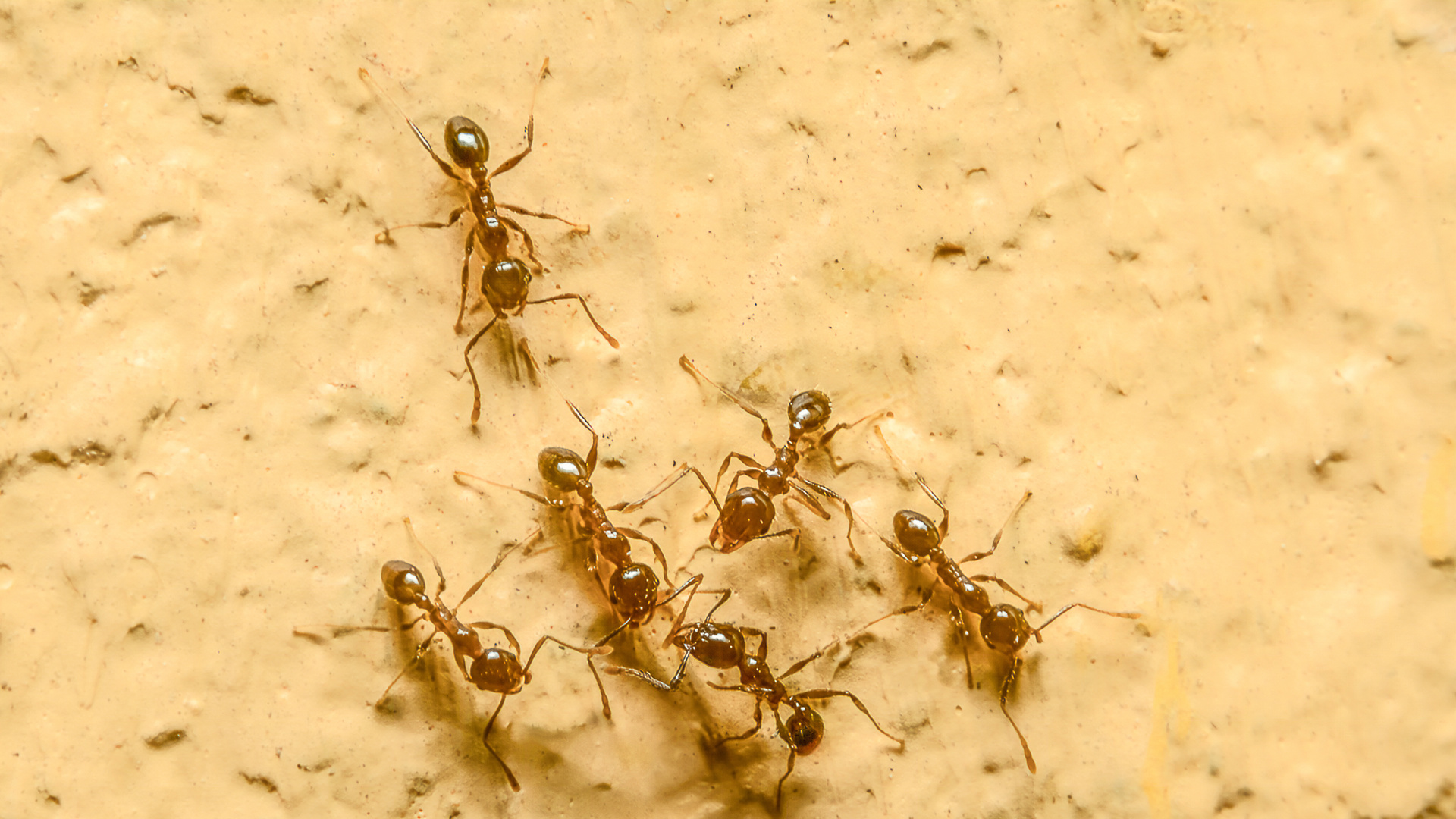
Most people call every small dark ant in the kitchen the same thing. Argentine ants are specific, though, and once you know the tells the ID takes seconds. Start with size: workers run just under an eighth of an inch and, unlike a lot of species, stay uniform — no big ones and small ones mixed on the same trail. Color is next: a shiny, even brown, never black and never striped. The real giveaway is how they move. Fire ants mob a spill and carpenter ants travel as loners, but Argentine ants stream in both directions along the same line in a steady single- or double-file column — orderly, almost like a commute. If you see a thin dark line holding that pattern across a counter or along a baseboard, walk it backward; the source is usually outdoors at a planter base or an expansion joint.
This is where Argentine ants stop behaving like other ants. Most species run one nest with one queen, so if you find and treat the nest, you're done. Argentine colonies don't work that way. A single colony holds many queens and spreads through budding — a queen and a handful of workers simply walk off and start a new satellite nest nearby. There's no dramatic swarm to spot, and no one nest to destroy.
Zoom out and it gets stranger. Argentine ants aren't native; they arrived in California in the early 1900s and have since pushed out most of the native coastal species. What's left is essentially one enormous supercolony — you can travel from San Clemente up to Newport Beach and never cross into rival territory, because the ants treat it all as the same colony. That's why a can of spray never ends it. You're not fighting a nest; you're borrowing a few feet of a network that runs under the whole cul-de-sac. Beating it takes a source-and-perimeter strategy, not a one-off treatment. (Our complete guide to ants in Orange County covers the other species we see year-round if you're not sure Argentine ants are what you have.)
Because the nest is spread out and mostly underground, you probably won't see one — the first real sign is traffic that doesn't slow down. Most people miss the first few workers. Then the colony finds sugar or standing water inside and the trail turns into a conveyor belt: grease rings at the stovetop, pet food bowls, and open recycling are the triggers we see most on inspection. Kitchens take the brunt of it, with trails concentrating along grout lines, cabinet corners, and sink basins. The traffic isn't the only tell, either — dead workers collecting along baseboards, and a faint musty smell when a cluster gets crushed, both mean the colony is established indoors, not just passing through.
Trails tell you more than anything else. A single-file line that holds steady for days means the colony has locked onto a food source; when it thickens into a broad stream, reinforcements have been called in. When we walk an active house, we trace trails in both directions before treating anything. Follow the line outward and you usually land at wet soil or a stacked woodpile. Follow it inward and it ends at whatever they're after. The one we find constantly in South OC is the kitchen-sink trail: ants come in under the sink, climb the drain line, and settle at the sponge or the water ring at the faucet base. Until that moisture gets fixed, no spray holds.
The instinct is to spray the trail. It's satisfying, and yes, it kills the workers you can see — but with a budding colony that's the worst thing you can do. Stress the ants and they simply split, scatter into new satellite nests, and come back worse a week later. The approach that actually works runs in a set order: bait first, then exclusion, then a perimeter treatment placed where the ants are truly entering — not on the visible line. If you want to take a swing at a small problem before calling, these help:
If traffic returns within two weeks, the colony is bigger than a consumer product can handle. That's when our residential pest control team steps in — full-perimeter treatment with non-repellent products the workers carry back to the queens, not a spray on the visible trail. (Chasing the aphids on your roses too? Ants farm them for honeydew — more on that in ants and aphids in South OC.)
If the trails are back every week, they won't break on their own. Our OSO360° plans are built around how Argentine colonies actually behave here: we lead with an inspection, treat with non-repellents so workers carry product back to the queens, and if pests return between scheduled visits, so do we. Call us at 949-818-1891 and we'll walk the property with you — no long-term contract, no pressure, and a clear digital report after every visit. Prefer not to call? Reach us through our contact page.
We cover coastal and inland South Orange County; the full list lives on our service areas page. The communities where we field the most Argentine ant calls:
Schedule an inspection or call us. Our local team is here to help.